
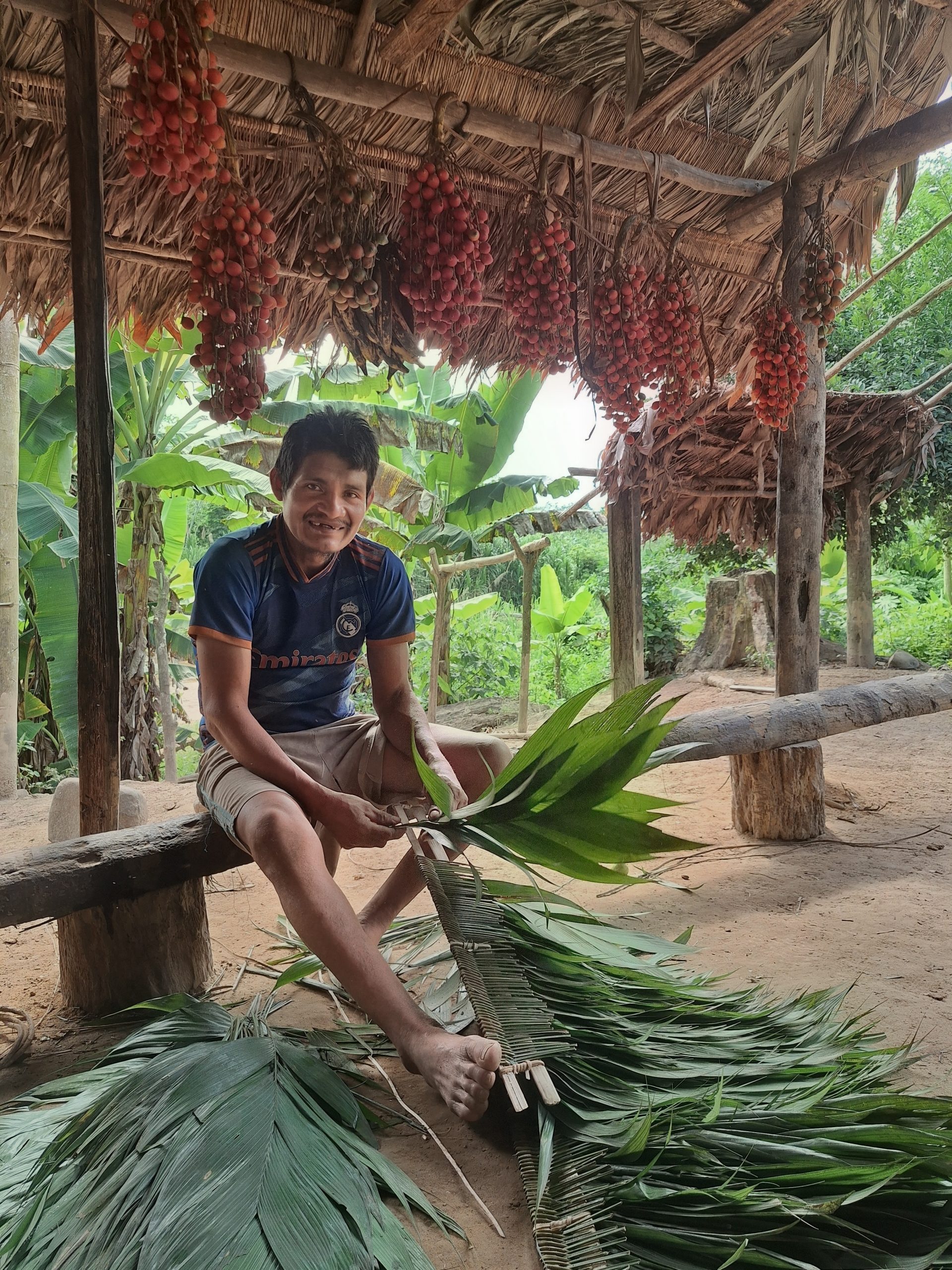
Jatata in Spanish, Cajtafa’ in Tsimane’, or Geonoma deversa in botanical terms, is a very important plant to the Tsimane’ people. It is a small palm whose leaves are used to make roofs that can resist the pouring tropical rains with ease for over ten years. Though this plant has kept the Tsimane’ comfortably dry in the past, it might even be more important to the people nowadays.
In the communities upriver, far away from the commercial town of San Borja, the entire economy is centred around this palm species. People harvest the leaves in the forest, carry the heavy bundles back to the community on their shoulders, and once at home they weave the leaves into paños as seen in the picture. These paños are then sold to traders that travel up and down the river with their canoes, and thus the jatata enters the national and international market where it is sold to make pretty roofs.
However, there are many issues with the jatata. In the past the Tsimane’ were violently exploited by traders to harvest the jatata. The forced labour is now largely a thing of the past, though new issues arise. The jatata is overharvested and people have to walk ever longer distances to collect the leaves, whilst forest fires, exacerbated by climate change, are threatening this important source of income. These weeks we are interviewing stakeholders in the jatata chain, uncovering the history of this plant, documenting the present economical drivers, and imagining future scenarios for sustainable harvest.