Written by Mireia Alcántara Rodríguez.
Balancing research with family life can be complex, especially during so-called fieldwork, even more so when it takes place in remote areas. We know there’s still a long way to go toward true work-life balance (especially for mothers) when it comes to children, but how do we manage it with a non-human dependent family member? During fieldwork, the greatest difficulty I’ve faced in my entire scientific career hasn’t been having to learn to navigate extreme environments (from the depths of the Amazon rainforest to the high páramos of the Andes), nor the humidity, heat, or cold; not even the mosquitoes (and other bugs determined not to overlook a single centimeter of my skin). Nor was it the uncertainty, the chaos, the fatigue, the erratic and endless schedules, or navigating different cultures, languages, and unstable sociopolitical contexts. What has truly been the hardest thing my heart has had to endure during these stays across the ocean has been being away from my four-legged companion: Golfito.
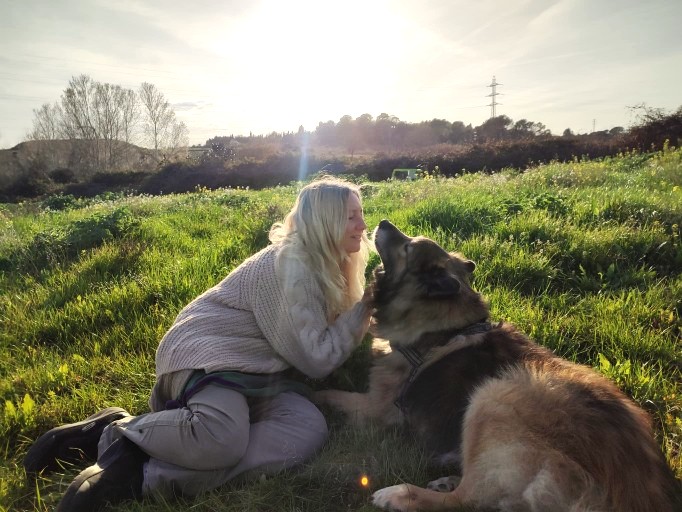
My dog has been my loyal companion for 15 years. He’s been there through the many times we’ve moved to different countries and homes, and he’s witnessed the various jobs I held while studying. He’s seen me graduate with my master’s degree and, a few years later, with my doctorate (obviously, he was rocking it at both celebrations). He listened to my academic presentations before any audience (and helped me manage the anxiety they cause me). He’s always been by my side while I wrote, analyzed data, or drove myself crazy trying to make sense of the intellectual jumble in front of me. He accompanied me on thousands of walks while I let my thoughts wander and organized my ideas. Golfito has been the only constant in my life over the past 15 years and throughout my entire career as an ethnobotanist. He has been my emotional, physical, and mental support; and I very much doubt I would have gotten to where I am today if it weren’t for him. He has been, is, and will always be the love of my life.
Whenever a field campaign came up, I faced a painful dilemma: being away from Golfito for periods of varying lengths. It hasn’t been easy, and I won’t go into too much detail about how I dealt with it (anyway, it was an impossible situation). Some comments I’ve had to deal with were: “He’s just a dog,” “You can get another one there,” “How can you leave him, since he’s an old dog?” Not only are these comments unhelpful, but they also show a significant lack of empathy. If anyone is going through a similar situation with their furry companion, you’re not alone! It’s not easy to balance a job like this while caring for our loved ones, and when it comes to non-human animals, unfortunately, the emotional and physical toll it takes is often neither understood nor acknowledged.
That’s why I thank from the bottom of my heart my family, my human life partner, and some of my friends for being there, taking care of Golfito when I couldn’t. Without these caring networks, I wouldn’t have been able to grow as a researcher in this way or have had the profound experiences and lessons I’ve gained in the field. Thank you also to the IEK-CHANGES team for their patience, encouragement, and support during my grieving process (both the anticipated grief and the grief I’m experiencing today). My work in Bolivia had to be cut short and postponed because of the care Golfito needed during the final phase of his life. The decision was clear: I wasn’t going to leave his side. But it all could have been much more difficult, especially if our PI, Álvaro, hadn’t offered me so much flexibility and empathy – for which I will be eternally grateful.
Finally, thank you, my Golfito, my baby, my sweet little wolf, for being by my side in this life. Without a doubt, the best adventure I’ve had so far has been with you. Tears stream down my face while I write these lines on the plane, as I realize, this will be the first time I land and you’re not at home to welcome me. But I know you’re still by my side, that we are weaved into each other, and that somehow, I’ll feel you again when I get home – a home of which you’ll always be a part of. No matter where we are, there are no longer any rainforests or mountains to separate us.